Multi-Drone Motion Planning
RRT-Connect & Decision Making under Uncertainty
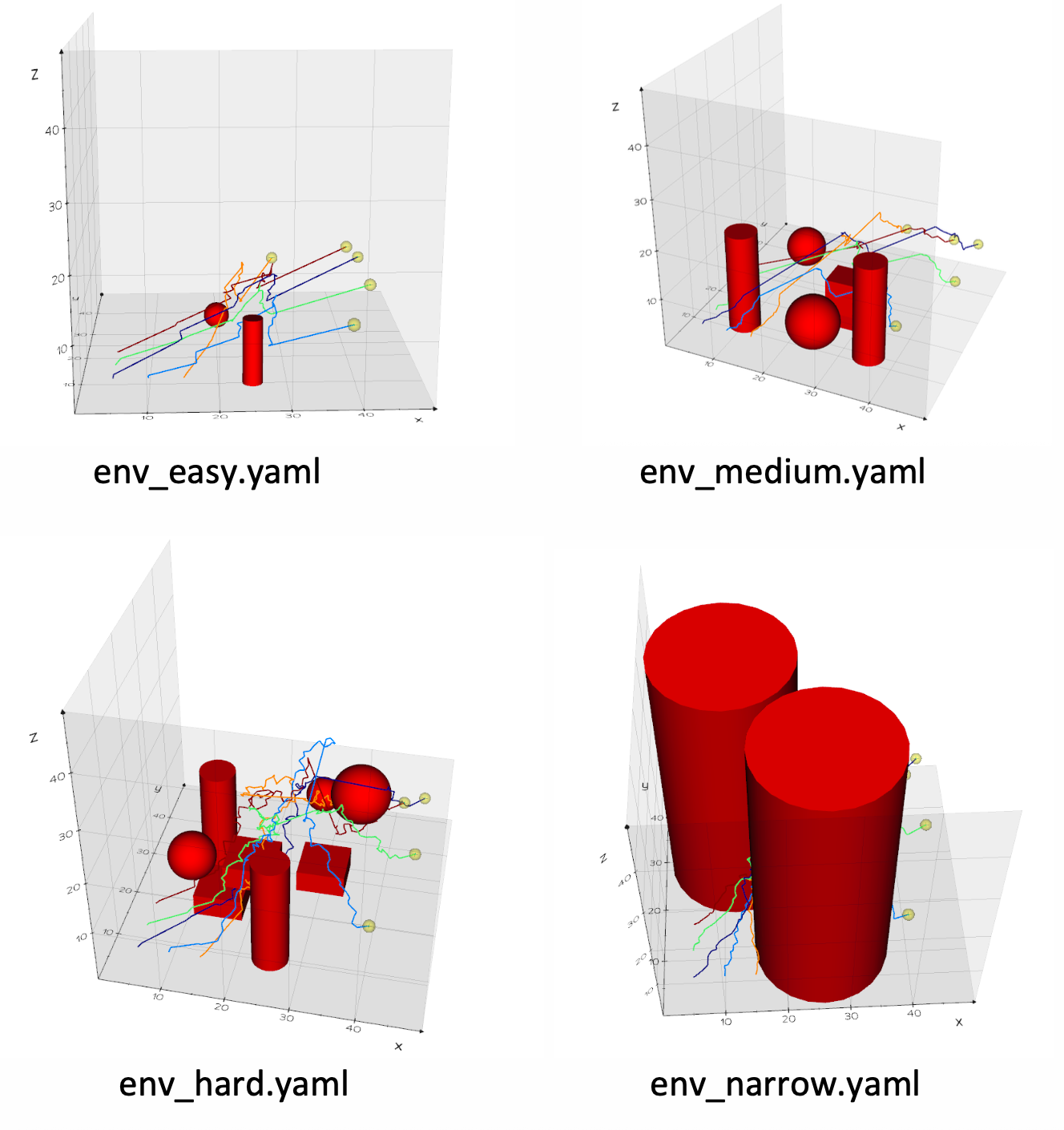
Completed two motion planning assessments. The first implemented centralized Bi-directional RRT-Connect in a 3K-dimensional configuration space for multi-drone collision-free path planning. The second implemented Monte Carlo Tree Search with UCT and progressive widening for decision making under uncertainty, using simulation-guided action selection and smart rollouts.
- → Model each drone as a 3D position (x, y, z)
- → Construct a 3K-dimensional joint configuration space
- → Grow two trees from the start and goal configurations
- → Randomly sample configurations and extend the trees
- → Check collision-free paths and connect the two trees
- → Extract and validate the final path
- → Analyse performance across different environment complexities and team sizes
- → Environment Complexity: Harder environments required more iterations and planning time, while narrow passages reduced the success rate to 76.7%.
- → Team Size: As the number of drones increased, planning time, tree size, and path length also increased, with success dropping from 100% for 1–4 drones to 73.3% for 8 drones.
- → Use UCT to balance exploration and exploitation
- → Apply progressive widening to control the growing action space
- → Use simulation-guided action selection and smart rollouts
- → Backpropagate discounted rewards through the search tree
- → Analyse performance across different team sizes and planning budgets
- → Team Size: With 8 possible actions per drone, the joint action space grew from 8 to 4,096 actions as the team size increased from 1 to 4 drones. Under a fixed planning budget, success dropped from 83% to 10%.
- → Planning Budget: Increasing the planning time from 0.5 to 3.5 s/step improved success from 16.7% to 56.7%, with diminishing returns beyond roughly 2–3 s/step.
What surprised me most was how quickly complexity became the main challenge in multi-drone planning. In RRT-Connect, the joint configuration space grew with the number of drones, while in MCTS-UCT, the joint action space grew exponentially. Across both assessments, I found that improving planning quality often came with a higher computational cost. This project gave me a better understanding of the trade-offs involved in designing scalable planning algorithms.